
What is Space Weather?
Space weather is “Sun weather” that can disrupt tech on Earth—and create auroras. Here is what actually causes it, what the numbers mean, and how to read tonight.
What is Space Weather?
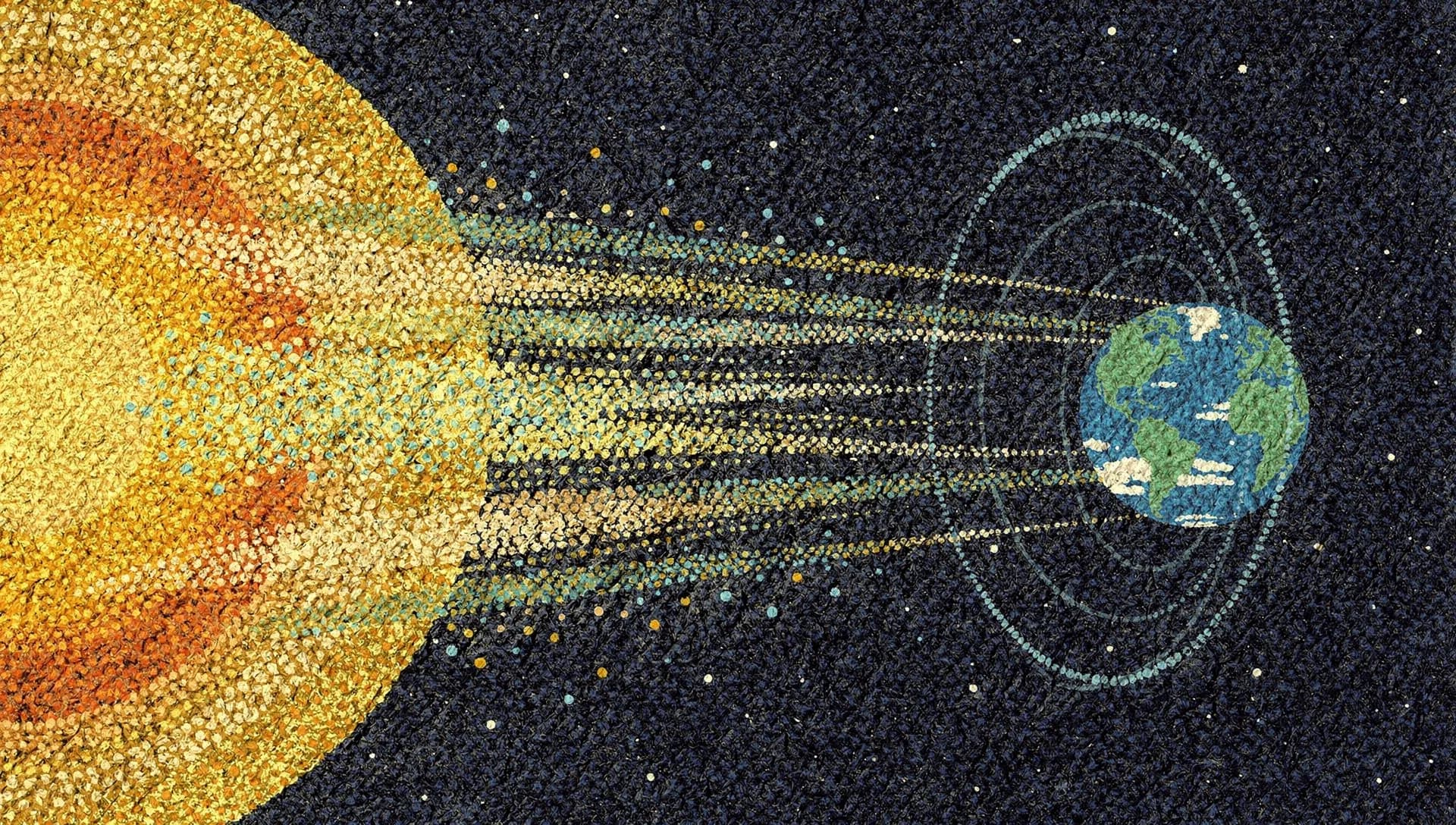
Space weather is basically “Sun weather.” It’s the changing conditions between the Sun and Earth that can affect our skies and our technology.
Ordinary weather is driven by the atmosphere. Space weather is driven by the Sun, and it plays out in the 150 million kilometres of space between the Sun and us. You can’t feel it on your skin, but it moves compass needles, degrades GPS, and paints the sky green.
Where it comes from
Almost all of it starts with the Sun, and it arrives in three different forms that travel at three very different speeds.
A solar flare is a sudden burst of radiation from an active region on the Sun. It travels at the speed of light, so it hits the sunlit side of Earth about eight minutes after it happens — there is no warning time at all. Flares are graded by their X-ray brightness in letter classes: A, B, C, M, X, where each letter is ten times stronger than the one before it. C-class flares are common and harmless. X-class flares can black out high-frequency radio on the daylight side of the planet within minutes.
A coronal mass ejection, or CME, is a different animal. It’s a huge cloud of magnetised solar material physically thrown off the Sun. It’s slower and heavier — typically arriving one to three days later — and it’s the thing that causes the big aurora nights. When a CME slams into Earth’s magnetic field, it compresses it and dumps energy into the upper atmosphere.
The solar wind is the constant background flow of particles streaming off the Sun all the time, even when nothing dramatic is happening. It carries the Sun’s magnetic field with it, and that turns out to matter enormously.
Why the direction of the magnetic field matters so much
This is the part that surprises most people. The single best predictor of a good aurora night isn’t how fast the solar wind is or how dense it is. It’s which way its magnetic field is pointing.
That measurement is called Bz. When Bz is negative — pointing south — it’s opposite to Earth’s own field on the dayside, and the two can link up in a process called magnetic reconnection. That opens a door, and energy pours in. When Bz is positive, the fields don’t connect nearly as well, and much of that energy is deflected around us.
You can have a fast, dense solar wind and see nothing, because Bz stayed stubbornly northward. You can have modest solar wind and get a beautiful display, because Bz went sharply south and stayed there. If you learn to read one number, learn that one — it’s on the solar wind dashboard.
Geomagnetic storms and the Kp index
When Earth’s magnetic field gets disturbed enough, we call it a geomagnetic storm. The most common way to measure the size of one is the Kp index, a 0–9 scale calculated from magnetometer readings at observatories around the world, updated every three hours.
Kp 0–4 is quiet to unsettled. Kp 5 and above is storm territory, and that’s where NOAA’s G-scale kicks in:
- Kp 5 → G1 — minor storm, aurora at high latitudes
- Kp 6 → G2 — moderate, aurora further from the poles
- Kp 7 → G3 — strong, aurora into mid-latitudes
- Kp 8 → G4 — severe, aurora well into populated areas
- Kp 9 → G5 — extreme, the once-in-years events
The critical thing to understand about Kp is that it is a planetary number. It describes the whole Earth at once. It does not tell you whether you can see anything — that depends on how far you are from the magnetic pole, which is a different thing from how far north you are on a map. Kp 6 puts aurora overhead in Tromsø and produces absolutely nothing in Madrid.
That’s why we built per-location forecasts: same Kp, translated into an answer for one place.
What it actually affects
Aurora is the pretty side. The practical side matters more to a lot of people:
- Radio. Flares ionise the upper atmosphere and absorb high-frequency signals. Aviation, maritime and emergency services on HF lose contact on the sunlit side — that’s the radio blackout scale.
- Satellites. Storms heat and expand the upper atmosphere, which increases drag on low-orbit satellites and changes their tracks. Energetic particles can also damage electronics and corrupt memory.
- GPS. A disturbed ionosphere delays and distorts the signals, degrading precision positioning — a real problem for surveying, agriculture and drilling.
- Power grids. Rapid changes in the magnetic field induce currents in long conductors. High-latitude grids are the most exposed. In March 1989, a severe storm collapsed the Hydro-Québec grid and left millions without power for around nine hours.
How to follow it on GalaxOS
A simple routine, in order:
- Check Alerts to see whether NOAA has anything active right now.
- Glance at the solar wind — Bz and speed — to see whether conditions are actually favourable.
- Check Kp for the overall storm level.
- Look up your own location to turn that Kp into a yes or no for tonight.
And remember that none of it matters if you’re clouded over, or if the sky where you are never gets properly dark. Both of those are on the location pages too.